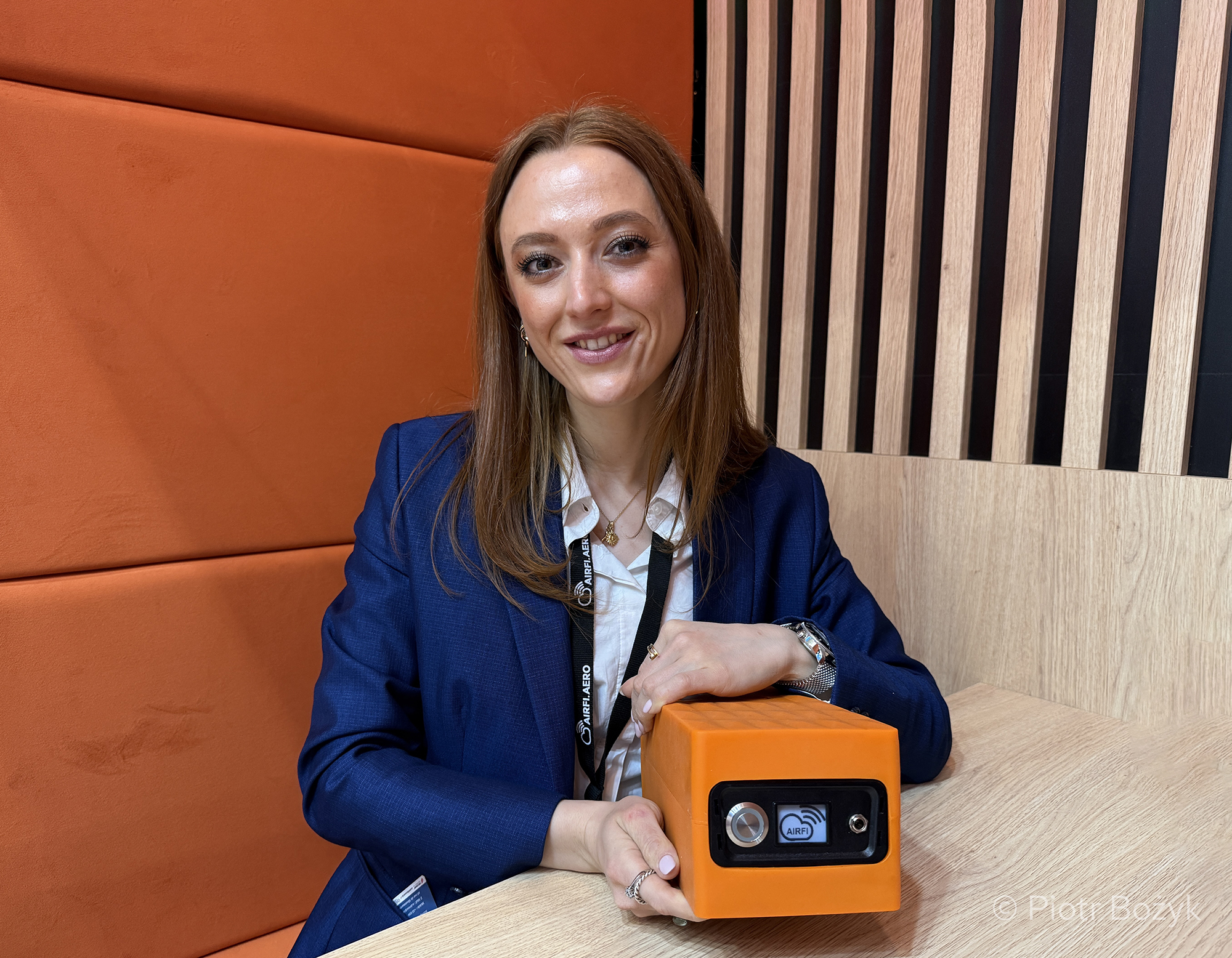
Laura Rosges, CEO of AirFi, during Aircraft Interiors Expo speaks with Piotr Bozyk about the future of onboard digital ecosystems, the growing role of intelligent personalization, and how satellite connectivity is reshaping the passenger experience. In her view, the next generation of inflight services will be defined not simply by internet access, but by the ability to integrate data, retail, payments, and destination services into one seamless ecosystem. AirFi aims to build on the rapid growth of onboard connectivity with AI-powered travel assistance, frictionless payments, and a new vision of inflight retail – increasingly described as “Shopify in the sky.”
AIX 2026 is heavily focused on digital-first passenger experience. How do you see AirFi shaping the next phase of onboard digital ecosystems?
We truly believe that in order to provide passengers with a relevant experience, you need to personalize it and that can only really be done digitally. In the past, we had paper menus for IFE retail, and it was a one-directional conversation. With digital solutions, and that’s why we say “digital-first”, you can gather information before the passenger consumes your product and provide relevant recommendations.
We believe that having a digital-only in-flight platform that is captive, intuitive, and capable of suggesting items based on a passenger’s behavior is one of our core strengths. That’s only possible when the experience becomes conversational, and that is inherently a digital characteristic.
That said, we also believe airlines shouldn’t move away from analog solutions too quickly. You want to educate passengers and bring them along gradually rather than shock them, especially passengers who may only travel once a year for a family vacation. They need time to become comfortable with these new digital experiences.
You’ve spoken about moving from “connectivity to intelligence” in the cabin, what does that shift look like in practical terms for airlines today?
That’s a good question. What I mean by moving from simple connectivity to an intelligent cabin is that connectivity itself is just a tool — an accelerator. The real value comes from connecting the dots.
It’s not about recreating the living room experience people have at home while they’re in the cabin. The important question is: what are you actually doing with that connectivity? Passengers are trying to pass the time, so can we suggest something meaningful to them at that specific moment? Can we guide them toward experiences, products, or services that are relevant to their journey?
In practice, this means far more APIs connecting airlines with ground crews, caterers, destination services, and other operational systems. It’s about aggregating data points, processing them on the ground where systems are more flexible, compressing that information, and then delivering it back to the aircraft in a way passengers can easily understand. From our perspective, that creates much more value than simply offering internet access.
For example, if you’re flying from Amsterdam to Mexico City for your honeymoon, connectivity allows you to pre-book transportation, reserve tours, arrange hotel services, or receive destination guidance before you even land. The system can also recognize that you have a layover and proactively suggest restaurants, services, or activities. At the same time, passengers remain connected to what’s happening at home through live news and updates. That’s intelligent connectivity. It also works operationally. Ground handlers can receive information about passenger flows, nationalities, customs requirements, and arrival logistics. It becomes a multi-directional ecosystem rather than simply “here’s the internet.”
What are the biggest misconceptions airlines still have about inflight digital transformation?
A lot of airlines still believe digital transformation is extremely costly and overly complicated — but it doesn’t have to be. If digital transformation is planned properly and you work with a supplier that helps define your goals clearly, implementation can actually be quick and focused.
That’s probably the biggest misconception we hear. Smaller airlines often think they don’t have the resources, while larger airlines are sometimes afraid of the scale of change. But digital transformation does not need to be complex.
Many airlines are switching to inflight internet, which raises the question: aren’t you worried about AirFi’s future? Despite the boom in in-flight internet installations, won’t this affect AirFi’s sales or offerings?
To be honest, I’d be delighted if more airlines adopt connectivity because, for us, it creates opportunities. Ideally, we would love every airline to operate with LEO-based managed-bandwidth connectivity because we believe it’s a very sustainable way to improve onboard services without negatively impacting the aircraft.
But whether airlines use Starlink, Hughes, Viasat, Panasonic, or any other connectivity provider, we can integrate with those systems and make our services more meaningful. The reason we originally entered the connectivity space was because there was a major market gap. Connectivity used to be very expensive and slow to deploy, and that limited what we could offer. Even a small amount of connectivity allows us to create far more meaningful experiences for both passengers and airlines.
For example, we want to gamify parts of the experience and introduce AI-powered travel assistants that help passengers plan their journeys before and after the flight. You can do some of that locally on the onboard server, but connectivity makes it far more flexible and scalable. At the same time, not every airline wants a fuselage-mounted antenna, and that’s where our solutions become particularly attractive.
Another important use case is fraud prevention. Originally, one of the primary reasons for onboard connectivity was enabling real-time payment verification. WhatsApp messaging came later. So if more airlines adopt connectivity, that’s actually great for us because it allows us to focus on building smarter services on top of that infrastructure. How quickly do you expect self-service ordering and payment to become the standard onboard experience? Right now, we’re actively encouraging our customers to move in that direction, and several already have.
I believe that by the end of 2027, every airline — regardless of how conservative or resistant to change it may be — will at least offer self-service ordering and payment as a parallel option. Replacing traditional payment terminals entirely will probably take until 2028 or 2029 because airlines have already invested heavily in existing hardware. But we already see strong momentum, and our customers are very happy with the results.
AirFi emphasizes lightweight, no-modification solutions, so how important is this approach for airlines operating mixed or older fleets?
It’s extremely important. For example, STC installations are aircraft-type specific, which means airlines need to plan them far in advance and dedicate significant time and resources to implementation. Many of our customers simply don’t have that luxury.
They want to fulfill promises to passengers quickly — often within a matter of months. If an airline operates ATRs, Embraers, Airbuses, and Boeings simultaneously, they need something standardized, safe, and easy to deploy — ideally something that can simply be mounted in the window with the proper certifications, without the complexity of STCs, Form 1 approvals, or extensive modifications.
You’ve been advocating for embedded payments and frictionless onboard retail, what’s the biggest barrier airlines still face in adopting this model?
Many airlines already have existing payment hardware contracts, so the challenge is partly financial, both CapEx and OpEx, but it’s also strategic. A lot of airlines still don’t fully understand the operational advantages this model offers. Self-service payments save crew members significant time, but they also require proper training. Crew members need to understand that passengers will increasingly browse, select, and pay for products directly on their own devices, while the crew simply fulfills the order.
Another challenge is that the right stakeholders are not always involved in the conversation. The people responsible for payments and retail strategy are often missing from these discussions, which slows decision-making. That’s why we always encourage airlines to bring those teams into the room so we can walk through the process together.
Is inflight retail becoming more like e-commerce platforms on the ground — “Shopify in the sky,” as you’ve suggested?
That’s absolutely the vision. We want to give airlines, or the retailers they partner with, the ability to recreate a complete shopping experience onboard while making it incredibly easy for passengers. They should be able to shop whenever they want, not only when the trolley comes down the aisle. They should also be able to access products beyond the physical inventory onboard through connectivity, digital vouchers, or destination-linked services.
And most importantly, payments should feel effortless. Passengers should be able to pay with a digital wallet exactly the same way they would at home. Because the moment you introduce friction, people stop buying. I’m exactly the same way myself, if the checkout process becomes complicated, I lose interest immediately. But if it’s simple and intuitive, people are far more likely to purchase. That’s the strategy we believe in.
Looking ahead to the next 2–3 years, what will define the winning inflight experience?
I think the winning in-flight experience will ultimately be the one that convinces the crew. Very often, discussions focus only on passengers or airline branding, but crew engagement and buy-in are equally critical. The best technology is almost invisible. It supports the crew, simplifies processes, and makes service delivery easier — regardless of whether we’re talking about payments, retail, or connectivity. That’s what will separate truly great providers from mediocre ones.
For example, how many boxes do you currently have onboard aircraft?
Right now, we have approximately 1,500 boxes operating across different fleets worldwide. The number required depends on the aircraft type and the level of functionality needed. For a Boeing 737, for example, you would typically need between two and three boxes. If you want full simultaneous streaming for all passengers, you may need three. Smaller aircraft usually only require one box, while wide-body aircraft may need five or six depending on usage intensity. The good news is that we’re currently designing our next-generation platform. After Venus, the next system will be called Maya, and it will significantly change deployment requirements. It’s expected to launch next year.
One more question about Connected Crew, how has this system evolved over the years?
Connected Crew started as a fairly standard point-of-sale application, but it has evolved into a much more intelligent and integrated platform. Today, it connects with IFE systems, ground operations, merchant platforms, and payment providers. It also supports bundled offers, retail strategies, and more personalized sales flows.
We believe retail is growing faster than entertainment, and we also believe retail can directly improve service quality. Selling products doesn’t only mean generating revenue. It also creates opportunities to provide complimentary items, improve food and beverage experiences, and ultimately increase passenger satisfaction and NPS. So we increasingly see retail becoming part of the broader service experience.
Do you plan additional applications or further developments in this direction?
Absolutely. Right now, we’re working on combining the Wingman travel concierge with entertainment and retail systems into one integrated platform. The idea is to proactively support both passengers and crew by intelligently suggesting products and offers based on context.
For example, if a passenger is watching a movie while flying from Madrid to Munich, the system might suggest snacks or bundled offers that fit the situation naturally. The goal is to create dynamic, personalized retail experiences that adapt in real time depending on the route, passenger profile, and behavior. That’s really where we see the future heading.